Finding volunteers for your race (and thanking them)
 Co-founder of Hudlo15. September 20269 min LesezeitVereinslebenArtikel auf Englisch

Three weeks before the club's race, the chair posts in the group chat again: "We still need marshals for Sunday!" Two thumbs-ups, one "I'll see", then silence. The day before, you ring the same loyal few one by one, fill the gaps with partners and spouses, and hope nobody drops out at 6 am. The problem isn't that people won't help. It's that you're asking them for "a hand" instead of offering a specific post, at a specific time, with someone to report to.
In brief
- Start from the course, not from a total: every junction, feed station and set-up job becomes a post to fill.
- In France, marshals have a regulated status: they must be adults with a valid driving licence, and they signal the right of way granted to the event.
- A specific, dated post with a duration and a set number of places gets filled far more easily than a general appeal.
- In Hudlo, each post becomes a mission: members sign up in one click, join the mission's chat and earn points.
How many volunteers does a race need?
There's no standard number: you count the need from your course and your programme. Take the map and list every spot where someone has to stand. Then add the jobs for the day before, the early morning and the evening.
Here you have a date, posts and times. Recruiting volunteers who stay all season is a different job: see our article on recruiting and keeping your club's volunteers.
| Post | What you need | Profile | Duration |
|---|---|---|---|
| Marshal | One or more per junction where the event has priority | Adult with a valid driving licence (French rule) | The whole time the race passes, plus the briefing |
| Feed station | One team per feed point | Anyone, families included | From set-up until the last rider or runner passes |
| Set-up and take-down | Barriers, finish arch, tents, sound system | Willing hands, ideally with a vehicle | The day before or early morning, then after the finish |
| Course marking | Arrows, tape, signs | Someone who knows the route | The day before, then clearing the markings |
| Transport | Equipment, food, bringing back those who drop out | Licence, van or trailer | Varies, often several round trips |
| Welcome and bibs | Bib collection, checking entries | Comfortable with the public | Before the start |
| Timing and finish | Recording times, results, prize-giving | Careful, sometimes trained on the timer's tool | From the start to the results |
Add a margin. There will be dropouts, and an empty marshal post can block a whole junction.
Marshals: a regulated post
A marshal (signaleur in French) is the volunteer who signals to other road users the right of way granted to the event. Under article R. 411-31 of the French Highway Code, a marshal must be an adult with a valid driving licence. Marshals follow police instructions. The French Ministry of the Interior confirmed this in 2023 in an answer to a written parliamentary question, declining to open the post to minors.
For a cycling sportive, the French Ministry of Sport's technical sheet puts barriers and marshals with K10 hand-held signs at junctions where the event has priority (“Course cyclosportive” sheet, in French). Rules vary by event and by country: check with the local authorities and your federation. Our checklist for organising a race or a sportive walks through the steps in order.
So a 16-year-old can't hold a junction in France. They can run a feed station, mark the course or welcome entrants.
Why appeals for help don't work
"We need people on Sunday" doesn't tell the reader what's expected or for how long. When in doubt, they don't answer. Three other things sink the search:
- Nobody can see what's missing. Replies get lost in the chat. A volunteer can't tell whether the feed station at kilometre 12 is already covered.
- The count lives in one person's head. The organiser knows who said yes, but the list isn't written down anywhere. If they fall ill the day before, everything starts again.
- Instructions arrive late, or not at all. Meeting time, post map, the organiser's number: without them, volunteers arrive anxious, or late.
If you don't use a tool
The method that works with a shared spreadsheet and a group chat:
- A table of posts, one row per post: place, time, profile, volunteer's name. Empty cells stand out at once.
- A single link to that table, sent to the whole club, rather than a general appeal in the chat.
- Short posts. A two-hour slot finds a taker more easily than a whole day.
- Marshals handled separately, with age and licence checked, and their list ready if the authorities ask for it.
- One lead per zone, reachable on the day, whose number is on every volunteer's sheet.
- A post sheet sent the week before: meeting point, map, equipment, times.
- A personal reminder to those signed up the day before, plus a list of stand-ins.
With Hudlo: one mission per post
In Hudlo, the Volunteering page of the club space gathers the missions. A club administrator creates the posts to fill there. Members see them on the web and in the iOS and Android app.
Create the mission
Click Create a mission. The form follows the order of your questions:
- General information: a clear Title ("Marshal, D12 junction", "Feed station km 12") and a Description of the tasks.
- Date & Location: Start date, End date (optional) for a two-day mission, Start time, End time, Duration (h) and Location.
- Registration: the Registration mode, Direct registration or Approval required if you want to validate each volunteer. That helps for marshals, whose age and licence you need to check. Number of volunteers needed sets the places; leave it empty for unlimited.
- Roles & skills: tags such as "driving licence" or "van" help people see where they fit.
- Attachments: the post map, instructions, the safety sheet, or a Link to a file.
- Options: tick Create a group chat when you create the mission. Volunteers are added automatically when they sign up.
Create one mission per post rather than one big "Sunday volunteers" mission. For example, a loop with four priority junctions gives four marshal missions, each with its own places.
Members sign up
Members who keep the Volunteering category on in their notification preferences are told about new missions. On each mission they see the date, time, place, estimated duration and remaining places. A button, I'll participate, signs them up. If they can no longer come, Unregister frees the place. Once every place is taken, the mission shows Full.
With Approval required, the request waits until you choose Approve or Reject. On your side, each mission's volunteer list stays up to date without any recounting. The evening digest, sent around 9 pm to the club's email address, also lists the day's volunteer sign-ups.
The mission's chat
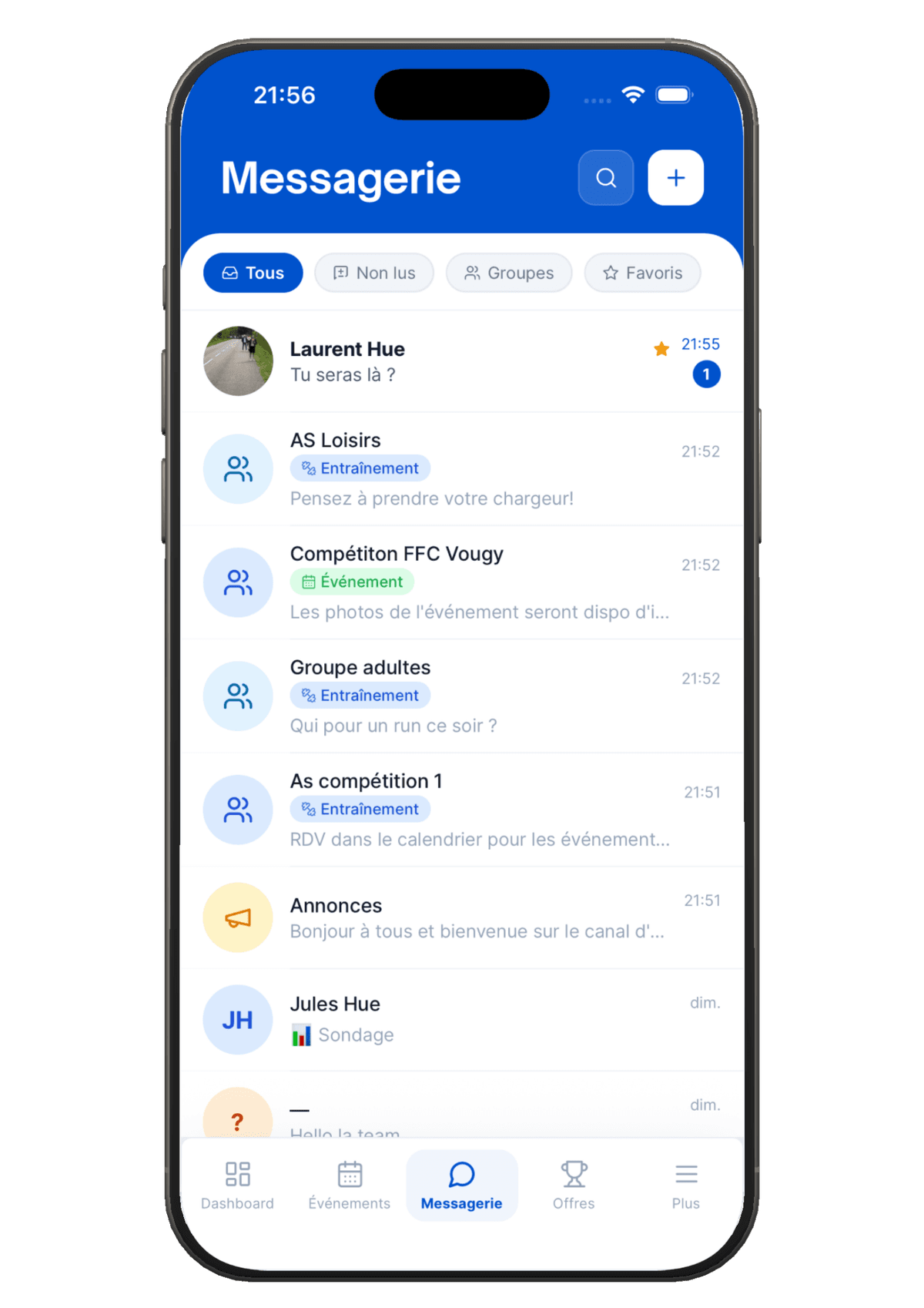
Each mission with a chat has its own conversation with everyone signed up. That's where you send the meeting time, answer questions and flag a last-minute change. The post's messages no longer get mixed up with the rest of the club's. It's the same idea as the club's groups, explained in our article on one conversation per group.
Points for those who help
In Hudlo, getting involved in the club earns points. Taking part in an event earns some. Taking on a volunteer mission earns more: it's the most valued kind of involvement. Points are exchanged for offers from Rewards & Offers. A weekly cap keeps earnings steady.
What about the people racing?
Volunteers are club members. Entrants often come from outside. A Ticketing ticket can be opened to the public with the Open to people outside the club box, and used for entries to your event. It needs unlimited places and no admin approval. You share the link or QR code, and entries arrive alongside the others in Ticketing. Details are on the club management page.
Hudlo's Volunteering page brings the club's missions together: members sign up in one click and automatically join the volunteers' chat. Each mission shows its date, place, duration and remaining places, with direct registration or approval. Taking on a volunteer mission earns more points than taking part in an event. See club management features
Saying thank you after the race
The race is over, but the work with volunteers goes on for another week. That's what brings them back next year.
- That evening or the next day, a message in each mission's chat: thanks, a figure from the day, a photo of the post.
- A personal note from the chair to zone leads and marshals, who held the most demanding posts.
- Ask for feedback: what was missing at the post? The answers help prepare the next edition.
- A public mention: on the club website, social media and at the annual general meeting.
- A moment together, even a simple one, after take-down.
In Hudlo, the points arrive without you having to think about it. Past missions stay under the Past filter, with everyone who signed up for each. You know whom to thank, and whom to ask first next year. For recognition across the whole season, see also how to keep your club's members engaged.
What it changes for the organiser
You stop posting "we need people". You publish posts, and you see which ones are still empty. Volunteers know where to go, when, and whom to message. If the organiser hands over, the list isn't on their phone: it's in the club. And the people who held a junction in the rain get thanked, by the club and through their points.
Further reading
- Organising a race or a sportive: the club's checklist - Paperwork, safety, entries: the steps in order
- Recruiting and keeping your club's volunteers - Finding volunteers who stay all season
- Club messages get lost: one conversation per group - Conversations that keep themselves up to date
- An endurance club's season, month by month - What the committee prepares, and when