Recruiting and keeping your sports club's volunteers
 Co-founder of Hudlo2026年6月5日阅读时间 7 min俱乐部生活英文文章

In France, more than 20 million people volunteer for an association, a large majority of them in sport. Grassroots sport relies almost entirely on the energy of volunteers who time races, organise competition weekends, handle the admin, coach young people and keep clubs going week after week.
Yet many club leaders end up carrying everything on their own. The problem isn't a lack of goodwill - it's often a problem of organisation, communication and recognition.
Understanding why volunteers disengage
Before recruiting, you need to understand why volunteers leave or refuse to get involved:
A workload that feels limitless. "I start helping and end up doing everything" - that's the number one obstacle. A volunteer who doesn't know where their role ends won't dare say yes.
Lack of recognition. No need for expensive gifts: a sincere thank-you at the general meeting, a mention on the club's website or social networks, a small gesture at an event is often enough.
No training. Many potential volunteers hesitate because they think they don't have the required skills. Show them that learning on the job is part of the plan.
Scattered information. When club decisions are made in informal meetings between the same people, other members can't see how to get involved.
The steps to effective volunteer recruitment
1. Define the roles before calling for help
Avoid generic appeals like "We need volunteers!" - they don't work. Instead, list specific roles with:
- A clear title ("Logistics lead for the spring race")
- A description of what it involves in practice
- An estimate of the time needed (2 Sundays a year, a 1-hour meeting each month...)
- Useful (not mandatory) skills
The more precise and limited the role, the more likely it is to attract someone.
2. Tap into the right sources
Your own members: they're your first pool. Many members would like to get involved but are waiting to be offered something concrete. Ask them directly, one to one, at the general meeting or via an online survey.
Members' families and friends: parents of young licence holders, members' partners - people who know the club from the outside and can bring specific skills (accounting, communication, legal...).
Volunteering platforms: JeVeuxAider.gouv.fr is France's official national platform for matching volunteers with associations. It's free and backed by the State.
Local organisations: your town's Maison des Associations, the CROS (Regional Olympic and Sports Committee) or the CDOS (Departmental Olympic Committee) can help you find volunteers or share your listings.
Local businesses: more and more employers offer skills-based sponsorship, meaning they make one of their employees available for a one-off assignment. It's legal, regulated and increasingly common.
3. Onboard new volunteers
A volunteer who arrives and doesn't know what to do will leave. Plan a simple onboarding path:
- A one-hour chat with a committee member to understand how the club works
- An introduction to the other volunteers and coaches
- Clear documents about the club (organisation chart, annual calendar, key contacts)
- Initial support in their role before leaving them to work independently
How to keep volunteers for the long term
Recognition, the cornerstone
Recognition doesn't cost much, but it's essential:
- Thank volunteers by name at the annual general meeting
- Mention what they've done on the club's social networks
- Organise an end-of-season meal or drinks just for volunteers
- Give them free access to club events
A small gesture with a big impact: a personal thank-you message from the president after a particularly well-run event is often worth more than a bonus.
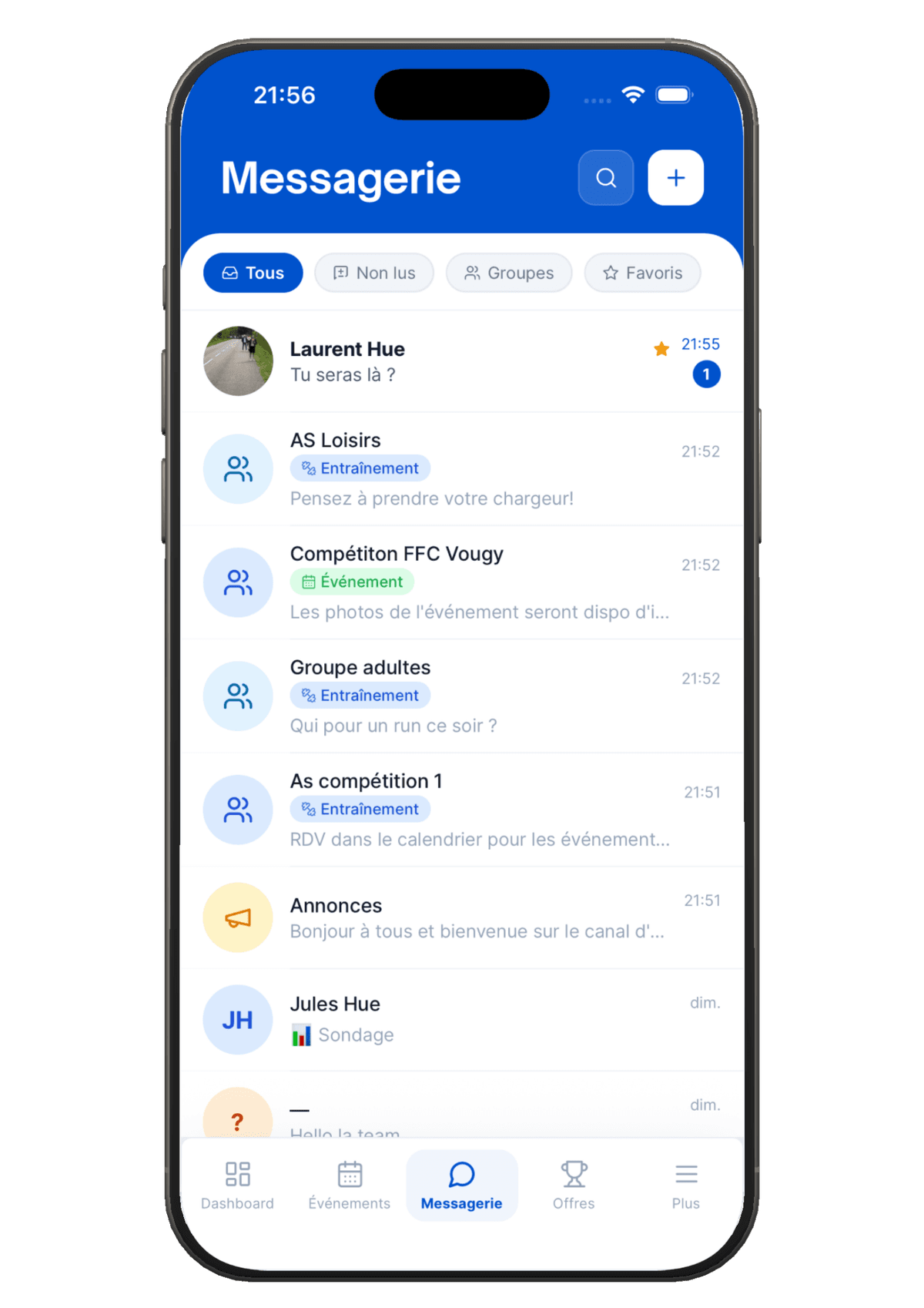
In Hudlo, every need becomes a volunteering mission (marshals, feed station, transport, set-up): members sign up, and those who do join the mission's chat. Recognition becomes concrete too: a volunteering mission earns more points than a training session, points the member converts into offers and cashback. See the member space
Training with FDVA support
The Fund for the Development of Association Life (FDVA) offers grants every year for volunteer training. Your club can get support to fund training in:
- Association management (accounting, association law)
- Coaching and running sports activities
- First aid (PSC1, PSE1)
- Digital skills
The FDVA is managed at regional level by the prefectures. Ask your regional directorate (DRAJES since 2021) or check the associations.gouv.fr portal.
The Citizen Engagement Account (CEC)
Since 2017, volunteers who carry out significant association work can earn training credits for their volunteering hours on their Personal Training Account (CPF) via the Citizen Engagement Account. This gives them access to training without using up their own CPF rights.
For the hours to be eligible, the association must have been declared for at least 3 years. Volunteers declare their hours themselves on the moncompteformation.gouv.fr portal.
Tell your volunteers about this scheme - they rarely know about it.
Clarify roles and responsibilities
One of the most effective ways to keep volunteers: give them real responsibility rather than a purely operational role. A volunteer entrusted with the club's communication, with genuine decision-making power, will feel far more involved than one who "helps out" with no title or autonomy.
Formalise roles in a simple organisation chart:
- Communication lead
- Competition logistics lead
- Youth academy lead
- Partnerships lead
What French law says about volunteers
A volunteer receives no pay. There are, however, legal ways to compensate their expenses:
Expense reimbursement: a club can reimburse its volunteers for actual expenses incurred in their role (fuel, tolls, meals when travelling). These reimbursements are not taxable provided they are backed up by expense claims.
Social Security flat-rate allowances: don't apply to volunteers. Only employees are entitled to them.
Protection in the event of an accident: a volunteer injured while carrying out their volunteer role is covered by the association's civil liability and personal accident insurance - provided that insurance has been properly taken out. Check your contract.
There must be no relationship of subordination: if a volunteer receives precise instructions about their hours, methods and day-to-day tasks, and this lasts over time, there's a risk it could be reclassified as an employment contract. Preserve your volunteers' freedom of action.
When should you hire an employee?
If certain roles are essential to the club's ongoing operation and require a regular, supervised presence, it may be time to hire an employee - even part-time.
Schemes supporting jobs in associations:
- Educational Engagement Contract (CEE): for leaders of holiday camps or day centres, allows payment by the day
- Support for jobs in the sports sector via the CREPS and regional sports services
Talk to your CDOS (Departmental Olympic and Sports Committee), which can point you to the schemes suited to your situation and budget.
Further reading
- Keeping your club's members engaged - The levers that keep your members from one season to the next
- Organising your club's general meeting - Notice, quorum, minutes: the steps to a smooth meeting
- Grants for sports clubs - Towns, departments, regions, ANS: building an application that gets through
- The club season calendar: a checklist for the committee - What the committee prepares, month by month, from September to August
- Finding volunteers for your race (and thanking them) - Marshals, feed stations, set-up: filling every post at your event