How to keep your sports club's members (without spending hours on it)
 Co-founder of Hudlo20 May 20268 min readClub life

Your club officially has 120 licence holders. But how many actually come to training? How many renew their membership from one year to the next? And above all: how many really feel part of club life?
If your renewal rate is falling from one season to the next, training attendance is falling or last-minute drop-outs keep happening, your club probably has an engagement problem.
The good news: keeping members doesn't take a huge budget or an unreasonable amount of time. Just a few clear principles, applied consistently.
Why your members (really) leave
The reasons people give when they leave are often polite excuses. "I don't have time any more", "it's too expensive", "I'm moving" usually hide deeper causes.
Reason #1: Feeling invisible
Mathieu signed up in September. He comes to training regularly, causes no trouble, pays his fee on time. In June, he doesn't renew. Why? Nobody ever really took an interest in him. No "how's it going?", no recognition of his progress, no social integration. He was a licence number, not a member.
What would have made the difference:
- A personal welcome when he arrived
- Regular check-ins with the coach about his goals
- Being added to an active WhatsApp group
- Public recognition of a performance, however modest
Reason #2: Admin friction
Léa loves her club, but renewing her membership is a nightmare. She has to download a PDF, print it, fill it in by hand, attach documents and post the lot with a cheque. For a generation that pays for an Uber in one tap, the experience feels like it's from the last century.
She ends up joining another club where everything is done online in 2 minutes.
What would have made the difference:
- A 100% digital renewal process
- A reminder email a month before the deadline
- The option to pay online or in instalments
Reason #3: Lack of communication
Thomas never knows whether Thursday's training is on or cancelled. He has to check three different places: the club WhatsApp (450 unread messages), email (some of which end up in spam) and sometimes the website (when it's up to date).
Every other Thursday, he turns up for nothing. After three months, he stops coming.
What would have made the difference:
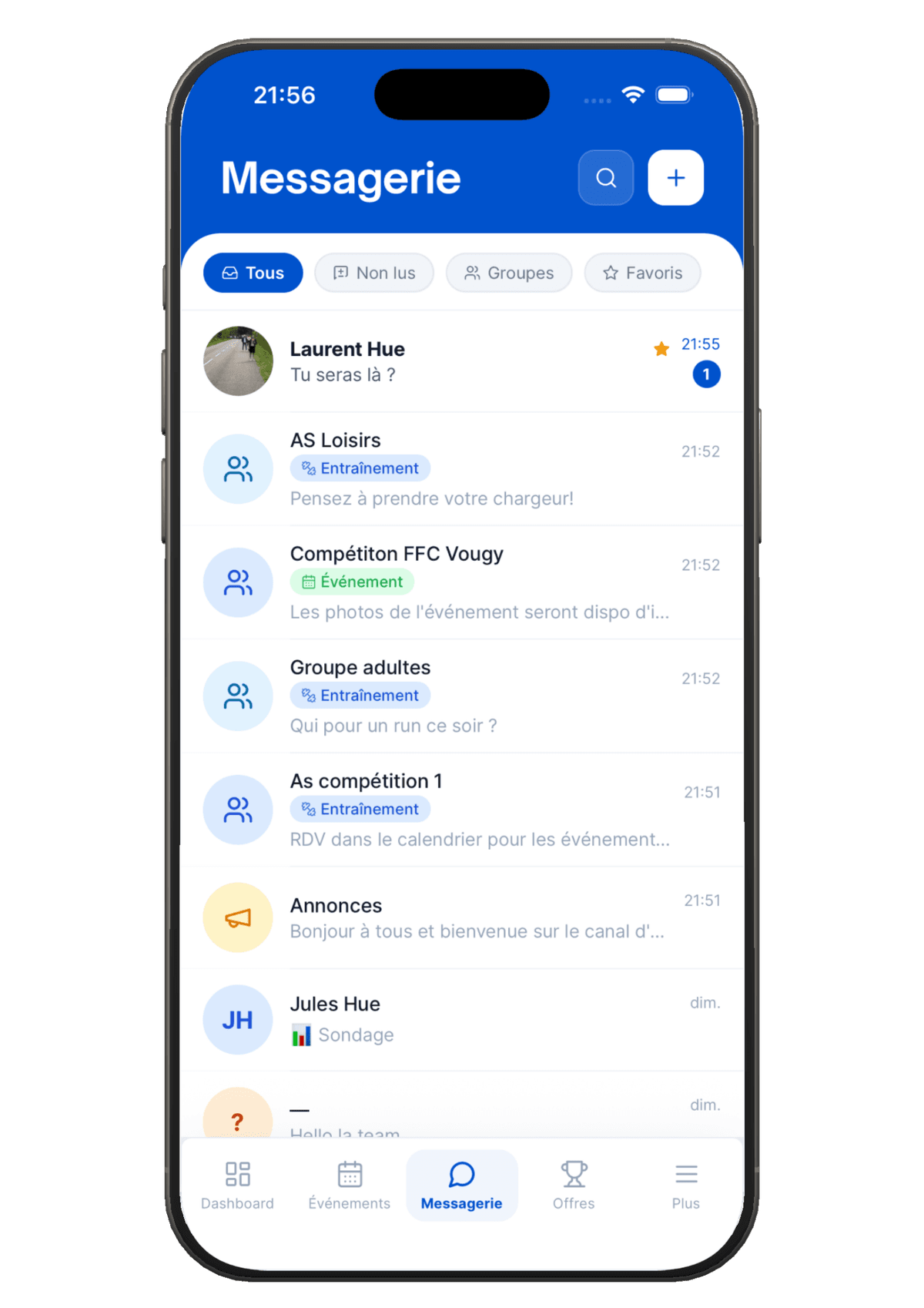
- A single platform for all communications
- Automatic push notifications when something changes
- An always-up-to-date schedule available in one tap
The 6 retention levers that work
1. Onboarding new members
A new member's first 30 days are decisive. That's when they form their image of the club and decide whether or not to stay.
An effective onboarding checklist:
- Day 1: a personal welcome email (not a generic template)
- Day 3: the coach introduces them to the group
- Day 7: a first one-to-one: goals, availability, expectations
- Day 14: placed in a sub-group according to level
- Day 30: formal feedback: "How do you feel in the club?"
2. Recognising progress
People need recognition. In a grassroots club, it rarely takes the form of medals or podiums - but it has to exist.
Effective forms of recognition:
- A post on the club's social networks after a performance
- A mention at the start of a session: "Well done to Julie who finished her first 10k on Saturday"
- A badge or status in the club app ("100 training sessions completed")
- Highlighting volunteers and contributors
Psychological tip: praise the effort, not just the result. "Well done to Marc for hanging in there despite the difficulties" builds more engagement than "Well done to Pierre who wins everything".
3. Creating rituals
Rituals create a sense of belonging. They're the little habits that make a member say: "This is how we do things here."
Examples of rituals that bring people together:
- The long Sunday morning ride followed by coffee
- Start-of-season / end-of-season drinks
- The annual volunteers' get-together
- The annual training weekend somewhere nice
- Handing out jerseys to newcomers at the start of the season
These moments don't need to be extraordinary. Their strength lies in their regularity and their ability to create shared memories.
4. Encouraging social interaction
A member who makes friends at a club is 3 times more likely to stay than an isolated member. Your role: create the right conditions for connections.
Practical actions:
- Mix groups regularly (avoid fixed cliques)
- Organise non-sporting activities (barbecue, cinema, games night)
- Pair long-standing members with newcomers for outings
- Encourage car-sharing (informal interaction)
The best friendships form in informal moments: the car journey, waiting before a session, the chat after training.
5. Transparency and proactive communication
Nothing wears down trust like opaque or late communication. Conversely, clear communication that comes early strengthens engagement.
Golden rules of club communication:
- Always inform members before they have to ask
- Explain important decisions (fee increase, schedule changes)
- Publish the accounts transparently
- Ask members for their opinion before major decisions
A member who understands why a decision is made accepts it far better than one faced with a fait accompli.
6. Giving engagement a financial value
Price is rarely the real reason for leaving - but improving the perceived return can make a difference.
Financial levers:
- Offer member perks (partner discounts, cashback)
- Offer payment in instalments (psychologically more accessible)
- Set up a referral scheme (a discount for both referrer and newcomer)
- Recognise volunteer hours (converted into a discount)
In Hudlo, every time a member takes part (a ride, an event, a volunteering mission), they earn points, and a volunteering mission earns more than a training session. Points raise the member's level and are exchanged for offers: a discount, cashback or a free product. No amount is promised: it depends on each member's activity and the offers available. See the member space
Measuring engagement (and acting in time)
You can't improve what you don't measure. Track these 4 indicators to spot problems before it's too late.
Renewal rate
Calculation: (Members renewing in year N+1 / Active members in year N) × 100
Rough guide (adapt it to your club):
- <60%: serious problem
- 60-75%: improvement needed
- 75-85%: decent
- >85%: excellent
If your rate drops, dig deeper: send an anonymous questionnaire to those who didn't renew to understand why.
Training attendance rate
Calculation: Number of attendances / (Number of members × Number of sessions) × 100
Rough guide (adapt it to your club):
- <40%: low engagement
- 40-60%: decent for a recreational club
- >60%: excellent
A member who comes fewer than twice a month is drifting away. Get in touch before they leave.
Net Promoter Score (NPS)
Question: "On a scale of 0 to 10, how likely are you to recommend this club to a friend?"
Calculation: % promoters (9-10) - % detractors (0-6)
Rough guide (adapt it to your club):
- <0: very problematic
- 0-30: urgent improvement needed
- 30-50: good
- >50: excellent
Send this survey once a year, mid-season.
Response rate to communications
If your club emails have an open rate <30% and nobody reacts to your posts, it's a warning sign: your members no longer read what you send.
Mistakes to avoid
Treating every member the same. A competitor doesn't have the same expectations as a recreational member. Segment your communication and your actions.
Launching initiatives without follow-through. One well-executed action per quarter is better than 10 ideas launched and then dropped.
Only talking about sport. A club is first and foremost a community. Social ties matter as much as sporting performance.
Waiting until a member leaves to act. By then, it's often too late. Step in at the first signs of disengagement.
Keeping members is a long-term investment
A club that keeps its members well:
- Saves hundreds of hours on recruitment
- Builds a stable financial base (predictable renewals)
- Creates positive momentum that naturally attracts new members
Loyalty can't be decreed. It's built week after week, session after session, through a thousand small gestures that make a member feel at home.
The best indicator of loyalty? When a member says "my club" instead of "the club".
Further reading
- Digitising your club's management in 2026 - The digital tools that make communication and organisation smoother
- Recurring payments for sports clubs - How spreading membership fees reduces drop-outs
- Sports club treasurer: the complete guide - Stabilising cash flow to invest in members' quality of life
- Recruiting and keeping your club's volunteers - Defining roles, recruiting, thanking and keeping your volunteers
- The club season calendar: a checklist for the committee - What the committee prepares, month by month, from September to August